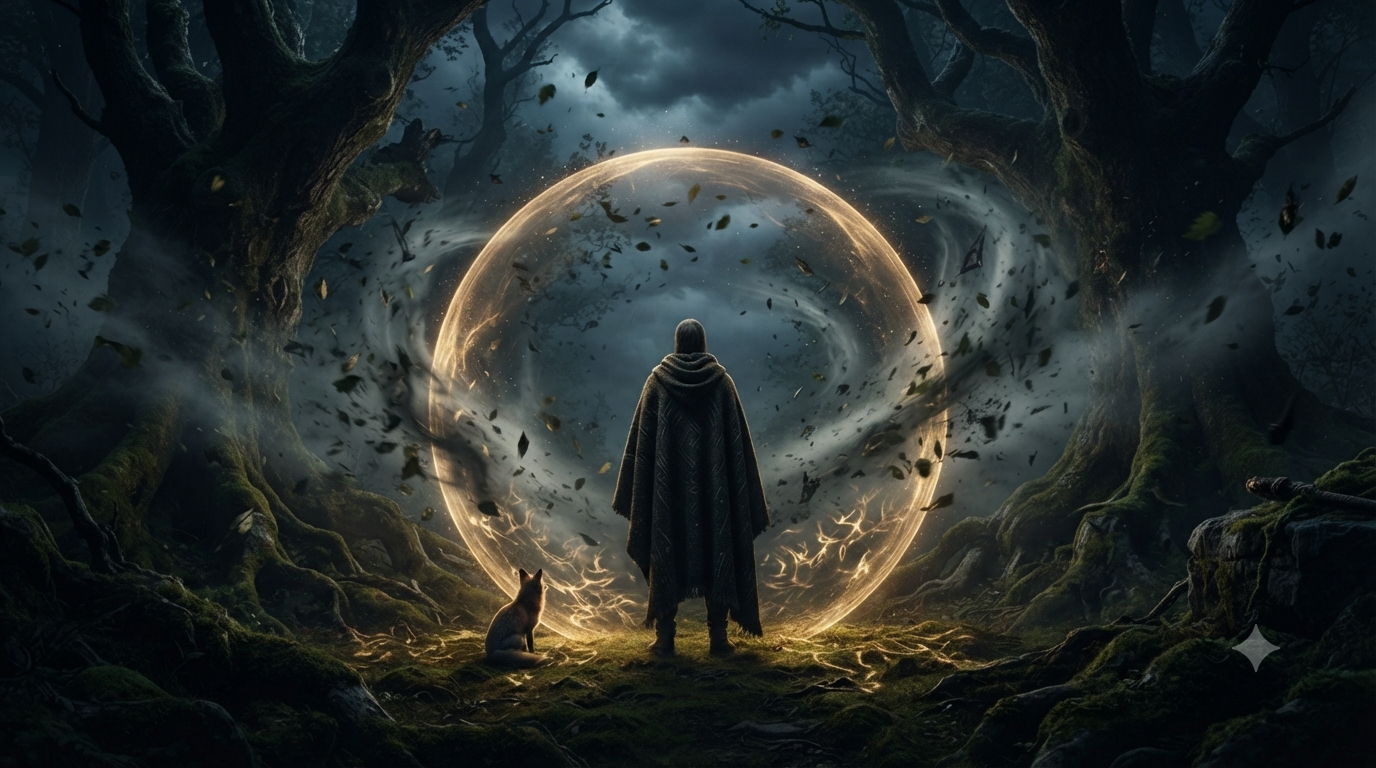
The Breath of Time: Why the Artificial Calendar Disconnected Us from Cosmic Order
The seven-day week is not a law of nature, but an engineering of productivity. A deep dive into the ancient cyclical perception of time, where darkness and inactivity are not evil, but the necessary inhalation of the soul.
Nature and its inhabitants care nothing for a week that has seven days. A wolf in the forest has no idea if it is Sunday or Wednesday. Trees do not govern their growth by the weekend. Animals and forests know only one time—the time that pulses through lunar phases and solar cycles. The modern seven-day calendar, which we have become so bound to, is entirely unnatural. It is a mathematical, uncompromising construct devoid of any spiritual charge, focused purely on performance, graphs, and a slave-like pace. Even historical attempts at "spiritual" calendars, such as the ten-day week, fall into the same trap of rigid logic. A true calendar must not serve the system. It must be in alignment with the frequency of the human body and soul.
🌔 For those returning to the natural cycles
🌒 The Celtic Calendar: Time as Breath, Not a Line
Proof of this natural perception of time comes from a unique European artifact—the bronze Coligny calendar tablet (2nd century CE). This is not some modern romantic reconstruction, but a precise lunisolar system used by our Celtic ancestors. The year was not chopped into artificial weeks; time was simply marked by the day of the month. The Celts did not perceive time linearly (beginning, evolution, end), but cyclically. To them, time was like a breath. Inhale and exhale. Spring as birth, summer as fullness, autumn as wisdom, and winter as death—not as a final tragedy, but as a sacred part of the great cycle.
🌘 The Illusion of Good and Evil: The Dualism of Matos and Anmatos
A month in the Coligny calendar had either 30 days (Matos) or 29 days (Anmatos). In today's world, scarred by Abrahamic dualism, we tend to divide reality into light (good/God) and dark (evil/demons). Pagan and esoteric worldviews do not recognize this illusion of pure good and evil. There is only balance and the flow of energy.
Matos (Favorable / 30 days): A time of expansion, light, and external activity (Yang). The season for hunting, celebrations, starting new projects, and planting crops that grow above ground. Energy flows outward.
Anmatos (Unfavorable / 29 days): A time of withdrawal, silence, and internal work (Yin). A period for introspection, healing, resolving disputes, and planting crops that grow beneath the ground (roots). Energy flows inward.
🌑 Embracing the Dark as Preparation for the Light
If we were to say that winter is "evil" because trees bear no fruit, we would be denying the very essence of nature. Winter is absolutely necessary so the forest can bloom again in spring. Therefore, Anmatos is not an "evil" or "cursed" month, as modern eyes obsessed with endless growth might see it. It is a sacred time of peace and preparation. While in Matos energy manifests outwardly, in Anmatos the inner world is healed and repaired. To fight the darkness is to fight your own inhalation.
Light and dark are merely the two halves of the breath of this world. If you are experiencing stagnation today, it may simply be that Anmatos rules your current phase. Do not march into battle when your energy is being called inward. True energetic sovereignty lies in the ability to align your internal rhythms with the Cosmic Order, not with the artificial spreadsheets of the system. ⚖️
IN AEQUUM 🕯️